
What makes us adaptive, intelligent and flexible?
Adaptive behavior, the ability to act and think flexibly in changing situations, learn novel contingencies and relationships, and generalize knowledge quickly, is a hallmark of human cognition.
Our lab investigates the behavioral, neural, and computational principles underlying this flexibility, which we call cognitive control.
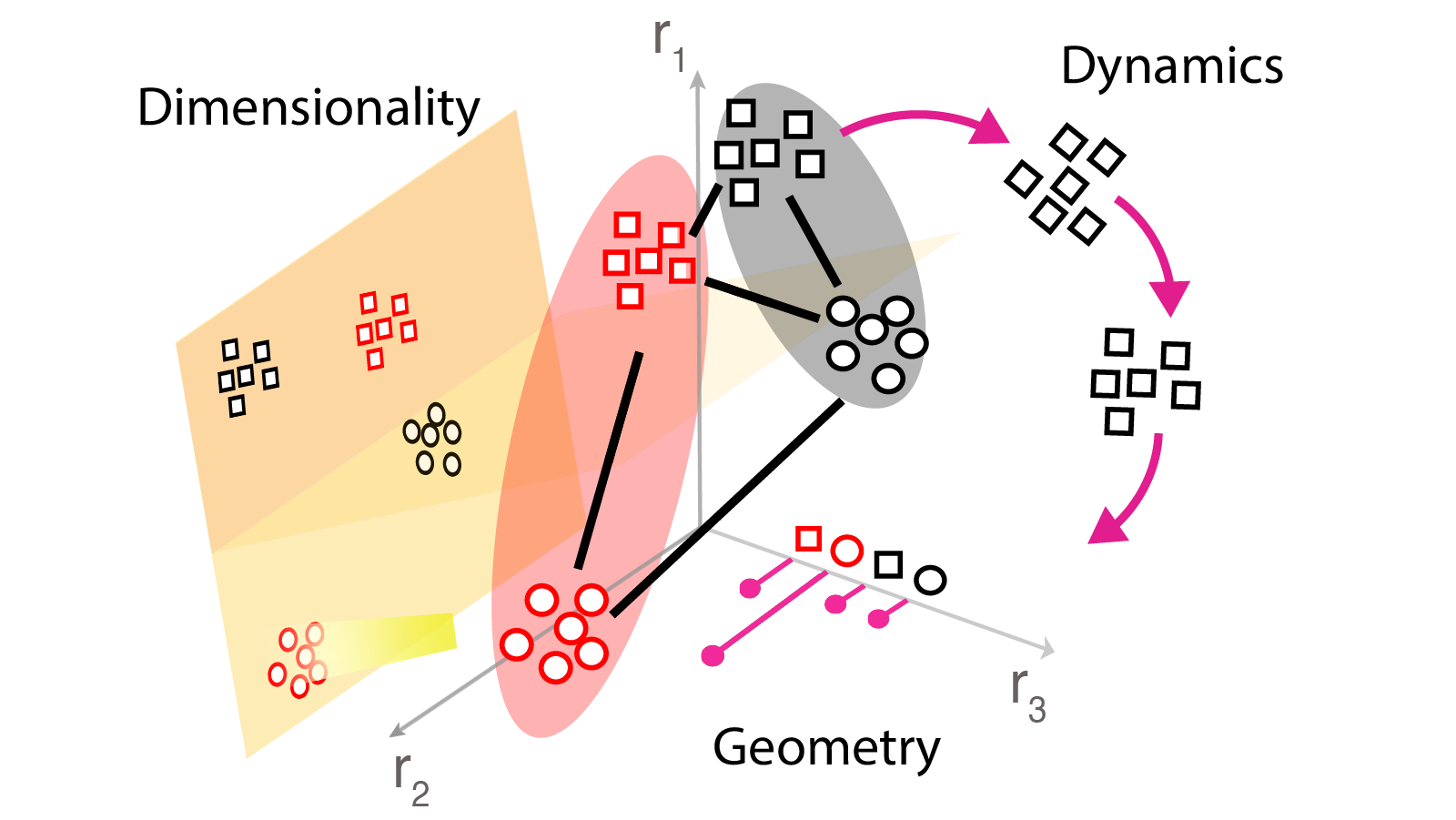
We study how the brain constructs and reshapes representations for tasks and goals, from moment-to-moment neural dynamics to causal brain circuits.
News
Archives
2026-09 – Five undergraduate research assistants joined the lab: Nathan, Timothy, Seoyoung, Sienna, and Ashlyn. Welcome to the team!
2026-09 – 🎉 The Cognitive Flexibility Dynamics Lab is officially open at the University of Maryland, College Park! Atsushi joined the Department of Psychology as an Assistant Professor, with affiliations in the Brain and Behavior Institute and the Neuroscience and Cognitive Science (NACS) Program. We are recruiting at all levels — see JOIN US.
2026-08 – Takuro presented Asymmetric interruption costs reflect transition structure shaped by task-neutral attractors (Zama, Kikumoto, & Shibata) at CCN 2026 at New York University.
2026-06 – Atsushi gave an invited talk for the Cognitive Psychology Colloquium at Leiden University.
2026-04 – 🏅 Honorable Mention Award at CHI 2026 for FIXical I/O (Lee, Vaichalkar, Dadarya, Chang, Kikumoto, & Nishida). Congrats Kyungyeon!
2026–2027 – Atsushi receives the Zimmerman Innovation Award, Carney Institute of Brain Science, for a project on modulating interoceptive circuits to enhance fear regulation in anxiety with TUS (Role: Key Personnel, PI: Frederike Petzschner; Total: $120,000).
2026–2027 – COBRE Center for Central Nervous System Function (Carney Institute of Brain Science), Pilot Project Award, Subspace Alignment as Cross-region Communication for Task Computations (PI: Apoorva Bhandari; Total: $100,000).
2025-09 – Atsushi presents at the Carney Center for Computational Brain Science, Brown University.
2025-02 – Atsushi gives an invited talk for the BrainMap Seminar Series at the Athinoula A. Martinos Center for Biomedical Imaging, Massachusetts General Hospital.
2025-02 – Atsushi presents for the Wang Lab at New York University.
2024-06 – Atsushi presents for the Woolgar Lab at the University of Cambridge.
2024-03 – Atsushi gives an invited talk for the Cognitive Control Collaborative at the University of Iowa.
2022 – Atsushi serves as a tutor for the BrainStorm Computational Modeling in EEG Workshop and Datathon at Brown University.
2021-11 – Atsushi presents for the Wouter Lab at the Washington University.
2020-05 – Atsushi presents for the Knight Lab at the University of California, Berkeley.
2021–2026 – Atsushi serves as Co-Investigator on the NIH R01
"The organization of neural representations for flexible behavior in the human brain."
2022–2025 – Atsushi receives the Dean's Faculty Fellowship at Brown University.
2021 – Atsushi receives the JSPS Overseas Fellowship (海外特別研究員).
2018–2019 – Atsushi serves as Co-Investigator on the JSPS KAKENHI Challenging Research (挑戦的研究萌芽),
"Assessing iconic memory using EEG time–frequency analysis."