
Dynamics, Geometry and Dimensionality
of Cognitive Control
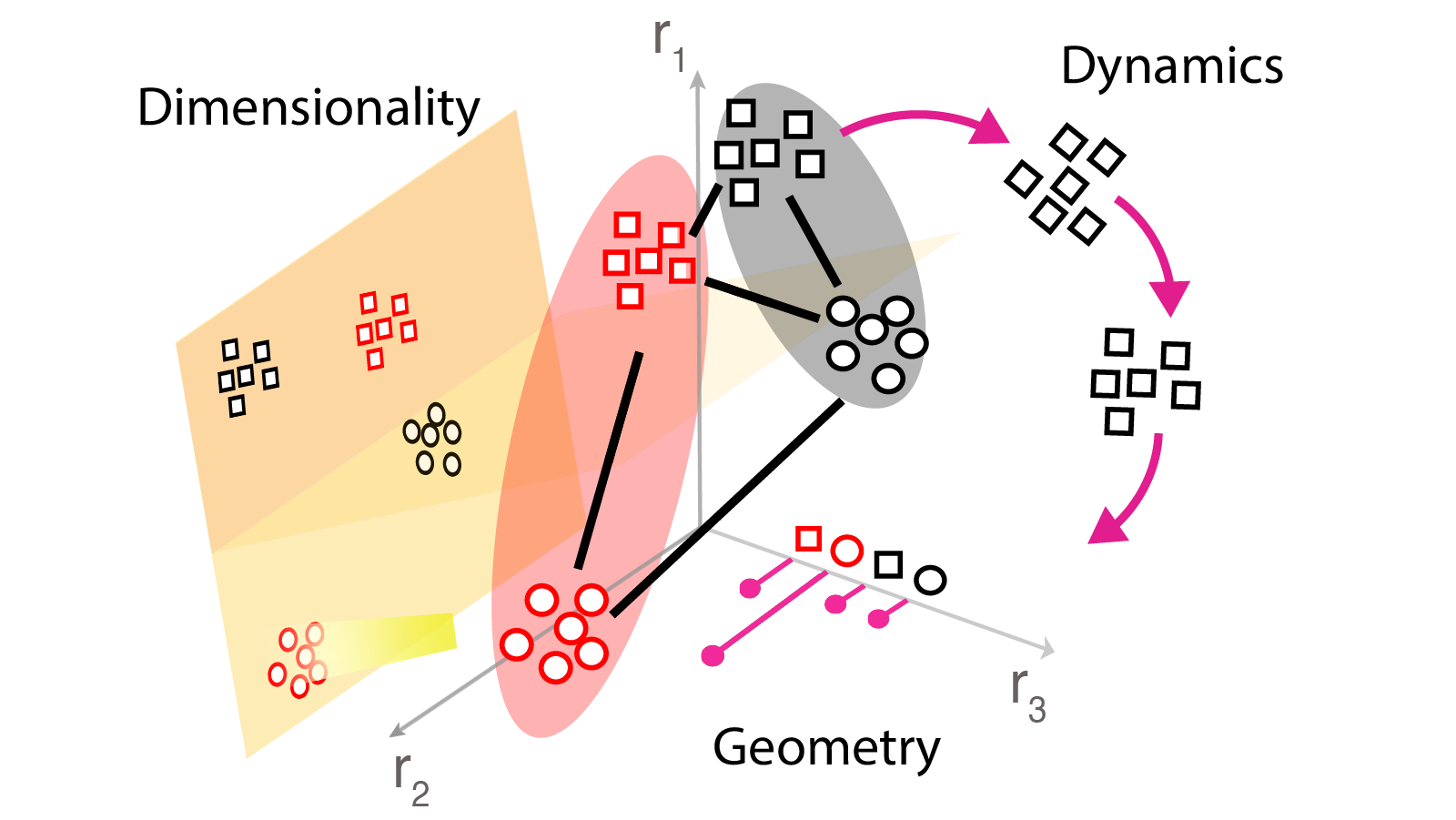
How do we translate and instantiate abstract goals?
To behave flexibly, the brain must encode and retrieve task information in a format that is both separable and generalizable—a fundamental tension in neural computation.
We investigate how the brain navigates this trade-off by examining the representational geometry, dynamics and dimensionality during cognitive control, and how these properties shift dynamically across time and with learning.
Related publications
Kikumoto, A., Shibata, K., Nishio, T., & Badre, D. (2025). Practice reshapes the geometry and dynamics of task-tailored representations. Cerebral Cortex, 35(8), bhaf125.
Kikumoto, A., Bhandari, A., Shibata, K., & Badre, D. (2024). A transient high-dimensional geometry affords stable conjunctive subspaces for efficient action selection. Nature Communications, 15, 8513.
Kikumoto, A., Sameshima, T., & Mayr, U. (2022). The role of conjunctive representations in stopping actions. Psychological Science.
Badre, D., Bhandari, A., Keglovits, H., & Kikumoto, A. (2021). The dimensionality of neural representations for control. Current Opinion in Behavioral Sciences, 38, 20–28.
Kikumoto, A., & Mayr, U. (2020). Conjunctive representations that integrate stimuli, responses, and rules are critical for action selection. PNAS, 117(19), 10603–10608.
Hubbard, J.*, Kikumoto, A.*, & Mayr, U. (2019). EEG decoding reveals the strength and temporal dynamics of goal-relevant representations. Scientific Reports, 9, 9051. * = equal contributions