
Structured Thoughts and Actions
How do we organize and structure complex knowledge?
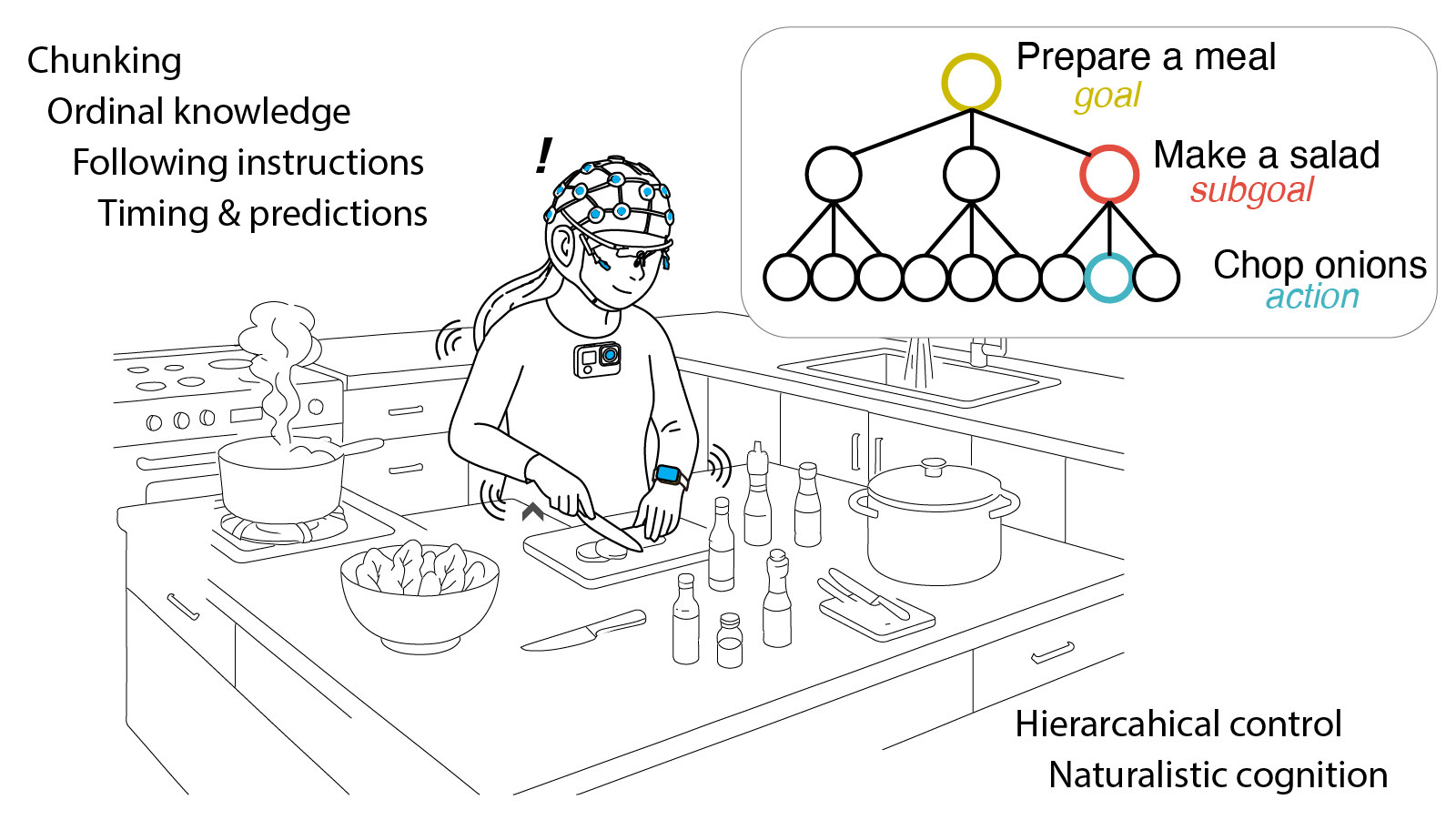
Adaptive behavior often requires not just selecting a single action, but organizing knowledge into structured sequences of thoughts and actions.
We study how the brain not only represents individual task elements, but organizes them into coherent structures—using content-agnostic representations—to achieve overarching goals.
Related publications
Lee, K., Vaichalkar, J., Dadarya, A., Chang, W., Kikumoto, A., & Nishida, J. (2026). FIXical I/O: Exploring the effects of real-time error sensing and physical intervention on finger-based motor sequence learning. ACM CHI 2026. 🏅 Honorable Mention Award
Kikumoto, A., & Mayr, U. (2018). Decoding hierarchical control of sequential behavior in oscillatory EEG activity. eLife, 7:e38550.
Mayr, U., Kleffner-Canucci, K., Kikumoto, A., & Redford, M. A. (2014). Control of task sequences: What is the role of language? Journal of Experimental Psychology: Learning, Memory, and Cognition.